1- Building Approach:
It is the first phase of the circulation system, and it varies. It can be perpendicular, oblique, or in this example frontal, leading directly to the entrance of the house.
 |


www.mocoloco.com
2- Building Entrances: (hopefully not this one....)

The entrance can be signified by planes, either actual or implied. The form of the opening can vary, and entrances can be grouped into flush, projected, and recessed. Entrances can also be centered or off centered. In the example below, the entrance is projected and centered, even though the design of the arch gives it certain asymetry.


3- Configuration of the Path:

It helps us understand the spatial layout of a building. It may reinforce or contrast a spatial organization. You can have linear, radial, spiral, grid, network or composite configurations. In this case, the spiral configuration revolves around the living room


4- Path-Space Relationships:
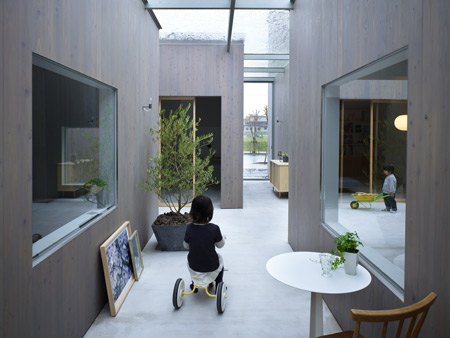
They are the relationships between the path and the space, which could be: Pass by spaces, pass through spaces, or terminate in a space. In the example, pass through spaces, the path is passing through the hallway in a curvilinear shape accentuating movement also with the use of color on the floor pattern.


5- Form of the Circulation Space:

It varies according to the definition of the boundaries, the relation to the form of spaces it’s linking, the entrances opening onto it, the presence of ramps or stairs. The circulation space can be enclosed, open on one side or on both. In this case, the stairway is helping leading the path from semiprivate to private spaces


2- Building Entrances: (hopefully not this one....)

The entrance can be signified by planes, either actual or implied. The form of the opening can vary, and entrances can be grouped into flush, projected, and recessed. Entrances can also be centered or off centered. In the example below, the entrance is projected and centered, even though the design of the arch gives it certain asymetry.
 |
Image: Otto Bock Building
. www.besthomegallery.com
|


3- Configuration of the Path:

It helps us understand the spatial layout of a building. It may reinforce or contrast a spatial organization. You can have linear, radial, spiral, grid, network or composite configurations. In this case, the spiral configuration revolves around the living room
 |
Image:www.thehousedesigners.com
|


4- Path-Space Relationships:
They are the relationships between the path and the space, which could be: Pass by spaces, pass through spaces, or terminate in a space. In the example, pass through spaces, the path is passing through the hallway in a curvilinear shape accentuating movement also with the use of color on the floor pattern.
 |
| Image: wellorder.com |


5- Form of the Circulation Space:
It varies according to the definition of the boundaries, the relation to the form of spaces it’s linking, the entrances opening onto it, the presence of ramps or stairs. The circulation space can be enclosed, open on one side or on both. In this case, the stairway is helping leading the path from semiprivate to private spaces
 |
Image: Tamami modern Interior Design source
|


I like that you have included additional images to help explain your thoughts.
ReplyDeleteI was about to say it too Stephanie! I always thought your pictures before the explanation and your diagrams are so cute and interesting:)
ReplyDelete